Chiang Mai's transport system is not complicated once you understand the layers. There is a public layer, a shared layer, an app layer, and a personal layer. Each serves a different purpose and price point. In 2026 a new electric layer has been added on top. This guide covers all of them with the specific decisions that will save you time and money from day one.
How to Get from Chiang Mai Airport to Nimman in 2026
This is the most searched transport question about Chiang Mai, so it gets answered first. You have four real options from CNX airport to Nimman.
- Grab or Bolt: Order from inside the arrivals hall. Expect 80-130 THB, 15-20 minutes in normal traffic. Fastest and easiest.
- Airport taxi (fixed fare): Walk to the official taxi desk outside arrivals. Fixed starting fare of 150 THB. Destinations beyond the Old City cost more. Reliable but pricier than Grab.
- RTC city bus 24 (24L or 24R): Leaves from the bus stop outside arrivals. About 50 THB from the airport, cash or Thai QR. Take 24R for Suan Dok and Nimman, 24L for the Night Bazaar, Warorot Market and Tha Phae Gate. Runs roughly 07:00 to 19:00, so check the timetable for a late flight. Fine if you have light luggage.
- Songthaew (private charter): Negotiate at the exit. Expect to pay 150-200 THB to Nimman. Price is higher at the airport than anywhere else in the city. Walk 50 metres from the exit before negotiating to improve your position.
If you are catching a flight during morning or afternoon rush (06:00-09:00, 15:00-18:00) and you are staying near the airport or heading south, the Wing 41 shortcut changes the equation entirely. More on that below.
The Songthaew System: Red Trucks and the Colour Network
The Songthaew (literally "two rows") is Chiang Mai's iconic red pickup truck with two bench seats in the covered bed. It is the backbone of city transport for locals and the most misunderstood system for newcomers.
The Red Songthaew: City Routes
The red Songthaews operate as shared taxis within Chiang Mai city. The base fare is transitioning from 30 to 40 THB per person for shared rides within the moat and nearby areas including Nimman and Santitham. Most drivers are now asking 40 THB, though you will still find the odd one charging 30 THB. Flag one down, state your destination, and the driver will nod if going that way or shake his head if not. You pay on exit.
For a private charter (you and your group only, going directly to your destination), negotiate before boarding. Within the city expect 60-120 THB depending on distance and your negotiating position. At tourist hotspots the opening offer will be higher. Know your route before you haggle.
The Colour Network: Suburban Songthaews
The city red trucks are only one part of the Songthaew system. A network of different-coloured trucks runs fixed routes along Chiang Mai's major roads out to the suburbs and surrounding districts. These are genuine public transport for outer-ring communities, not tourist vehicles.
| Colour | Route / Area Served | Est. Fare |
|---|---|---|
| Red | City centre (within moat + Nimman + Santitham) | 30-40 THB shared |
| Yellow | Chiang Mai University loop and Suthep Road corridor | 20-30 THB |
| Green | San Kamphaeng Road heading east (handicraft villages, Bo Sang) | 15-40 THB by distance |
| Blue | Chiang Mai-Lamphun Road south (Lamphun town) | 20-50 THB |
| White | Superhighway outer ring, Mae Rim direction (north) | 20-50 THB |
| Orange / Pink | Hang Dong and San Pa Tong direction (south, via Airport Road) | 20-50 THB |
The suburban Songthaews run fixed routes but do not have fixed schedules. They depart when reasonably full. At busy interchange points (the Promenada junction, the Airport Road / Superhighway junction, the Nawarat Bridge area) you will see groups of coloured trucks waiting. Walk to the correct colour, confirm your destination with the driver, and board. Pay on arrival at your stop.
These trucks are the only realistic public transport option for daily commuters living in Hang Dong, Mae Hia, San Sai, or Mae Rim who work in the city centre. A 40-minute commute costs 40 THB. Nothing else comes close on cost.
LOMO EV Tuk-Tuks: Quiet, Electric, Mostly Booked as Tours
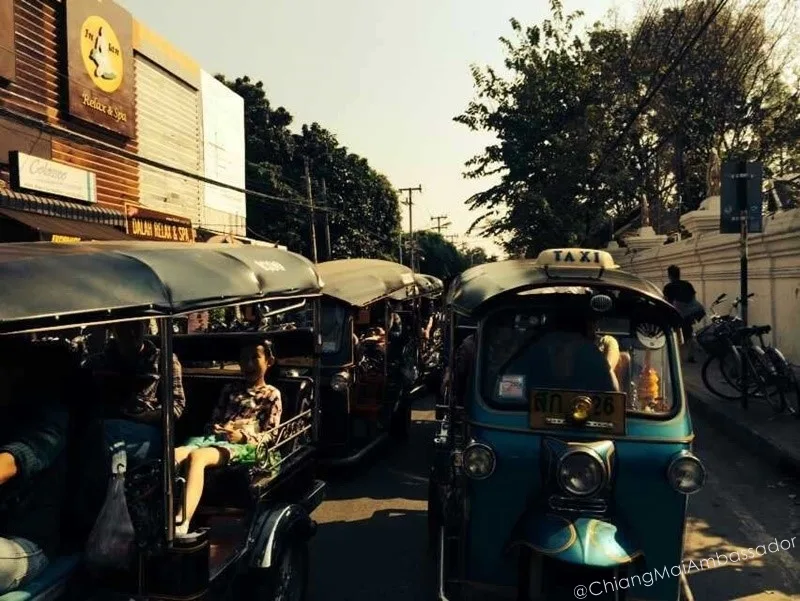
LOMO runs a fleet of electric tuk-tuks in Chiang Mai. They are quiet, there are no fumes, and they add nothing to the valley's trapped PM2.5 during the smoky season (February to April).
LOMO is sold mainly as guided tours and hourly hire with a driver: temple runs, morning market trips and Old City loops, booked through LOMO or travel sites such as KKday, Pelago and TAGTHAi. Expect roughly 1,500 THB and up for a half-day. Some guides say you can also book single rides in the LOMO app for around 60-150 THB. I have not been able to confirm current per-ride fares, so check the app before you count on it.
When to use LOMO: a half-day of temples or markets with older parents or kids, or when you want the tuk-tuk experience without the haggling. For simply getting from A to B, Bolt and Grab are still cheaper and quicker to book.
The App War: Grab vs Bolt vs Maxim
The single most useful habit you can develop in Chiang Mai is checking all three apps before confirming any ride. The price difference on the same journey can be 30-50 THB. Over a month of daily rides that is real money.
Grab
Grab is the market leader and the default for most expats and visitors. Its safety infrastructure is the best of the three: in-app emergency button, live trip sharing, vetted driver photos, plate verification. GrabFood integration makes it the super-app of choice for the Nimman nomad crowd. Pricing is the highest of the three on average, and surge pricing during rain or rush hour can push a 90 THB ride to 180 THB.
- Best for: Airport runs, rain, late night, unfamiliar routes, carrying valuables.
- Typical city ride: 80-150 THB (car), 40-70 THB (bike).
- Guru rating: 4/5. Reliable but the premium adds up.
Bolt
Bolt is the mid-range workhorse. Driver availability is stronger in Santitham and the outer residential rings where Grab's network is thinner. Pricing typically runs 10-20 THB cheaper than Grab on equivalent journeys. The app is cleaner than Maxim and driver quality is consistent.
- Best for: Daily city commutes, Santitham and outer suburbs, reliable backup to Grab.
- Typical city ride: 70-130 THB (car).
- Guru rating: 4/5. Check Bolt first on any journey under 15 kilometres.
Maxim
Maxim is frequently the cheapest for longer-distance runs. The 25-kilometre trip to Hang Dong, Mae Rim, or San Sai where Grab prices aggressively, Maxim will often undercut by 40-60 THB. The trade-off is car quality variability. Maxim's driver pool includes older vehicles and the app experience is less polished. For a daytime rural run where you know the route, it is excellent value.
- Best for: Long-distance trips to outer suburbs and districts, daytime use, budget priority.
- Typical long-distance run (to Mae Rim): 120-180 THB vs 160-240 THB on Grab.
- Guru rating: 3/5 for city, 4/5 for rural runs.
The App Decision Rule
Check Bolt first. If unavailable or expensive, check Grab. For anything going past the Superhighway ring road, open Maxim as your rural backup. Never accept the first price from any single app without a 30-second comparison check.
The Wing 41 Shortcut: 2026 Rules
Wing 41 is the Royal Thai Air Force base that sits between the Nimman area and Chiang Mai International Airport. For years, residents with the free annual pass sticker could use the internal road as a bypass, cutting 15-20 minutes off the journey during moat traffic congestion.
In 2025, with traffic and road works choking the approach roads, the base eased the rules. The Wing 41 bypass is open without a pass during rush hour: 06:00-09:00 and 15:00-18:00. You present a valid ID or passport at the gate, the guard logs you, and you pass through. It was never announced as permanent, but as of November 2026 we have not heard of it ending.
Outside these windows, the route is for pass holders (daylight hours on weekdays) and military personnel. The pass is free and valid for a year; 2027 renewals and new applications run until 25 December 2026.
Practical value: If you are catching an early morning flight or returning to Nimman during the afternoon rush, the Wing 41 route removes the moat and Huay Kaew Road congestion entirely. The time saving is genuinely 15-20 minutes during peak periods.
Dress code enforced at the gate: Helmet if on a motorbike (non-negotiable). Shirt required for both driver and passenger. Shorts are acceptable. This is a military installation and the gate staff take the dress code seriously. A singlet will get you turned around.
See the dedicated Wing 41 guide for the sticker application process if you make this trip regularly.
RTC City Bus 24: The Airport Loops
The old R3 Smart Bus route is gone. From the airport, the RTC city bus now runs as route 24, split into two loops. 24R heads west via Suan Dok to Nimman and One Nimman. 24L heads east via the Night Bazaar, Warorot Market and Tha Phae Gate. Both pass Old City gates and both return to the airport.
The fare is about 50 THB leaving the airport and 30 THB going to it. Pay in cash or by Thai QR, and do not count on a foreign contactless card. Buses run roughly 07:00 to 19:00, so a late arrival means Grab or a taxi. The timetable has changed several times since the route launched, so check the latest at the airport before you rely on it.
It is the cheapest air-conditioned way into town, and a good way to learn the city's layout when you first arrive. With two big suitcases, Grab is less hassle.
The Chiang Mai Tram: 20 THB Round the Old City
The newest way round town opened on 18 November 2026: the Chiang Mai Tram by Lannatique. It looks like a tram but runs on tyres, not rails. It is an electric, air-conditioned 12-seat bus styled as a tram, run by Asset World Corp as a social enterprise. I saw one running the night after it opened, so it is very much the real thing.
The loop is 13.8 km and takes about 40 minutes. A tram leaves every 15 minutes from 10:00 to 21:00, every day. There are 15 stops:
- A1 Zheng He Heritage House
- A2 Lannatique
- A3 Wat Sri Don Chai
- A4 Suriwong Book Centre
- A5 Wat Chedi Luang
- A6 Wat Phra Singh
- A7 Wat Lok Moli
- A8 Chang Moi Creative District
- A9 Warorot Market (Kad Luang)
- A10 Tha Phae Soi 1
- A11 Wat Mahawan
- A12 Tha Phae Gate
- A13 InterContinental Chiang Mai The Mae Ping
- A14 Chiang Mai Ancient House
- A15 Meliá Chiang Mai
Fares and Tickets
A single ride is 20 THB. A day pass with unlimited rides is 99 THB, so it pays off from your fifth ride. Longer passes start at 450 THB. Passengers aged 60 and over and children up to 90 cm ride free. You buy tickets online for a chosen date, get a QR code by email, and scan it each time you board. Tickets are non-refundable.
Sundays
On Sundays the tram skips Wat Chedi Luang and Wat Phra Singh because of the Sunday Walking Street. Use the Tha Phae Gate stop for the market.
Who it suits: visitors doing temples, Warorot Market and the riverside in one day, and older residents, who ride free. It is not a commuter service and does not go to Nimman or the airport. The loop and times are brand new, so check the operator's live map before you plan around them.
Is It Legal to Drive a Scooter with a Foreign Licence in Chiang Mai?
This question catches more foreigners out than any other transport issue in Chiang Mai. The short answer: your home country driving licence alone is not sufficient.
To legally ride a motorbike or scooter in Thailand as a foreigner you need one of the following:
- A Thai driving licence (motorbike category), or
- An International Driving Permit (IDP) with a motorcycle endorsement, carried alongside your home country licence.
The IDP must specify motorcycle/motorbike, not just car. An IDP issued for car-class only does not cover a scooter. Many people arrive with an IDP obtained at home that covers only the car category and assume it is sufficient. It is not.
The checkpoint reality: Chiang Mai runs daily police licence checkpoints, particularly on the Superhighway, Huay Kaew Road, and the main roads in and out of the Old City. The fine for an unlicensed or inadequately licensed rider is 500-1,000 THB on the spot. Beyond the fine, if you are involved in an accident without a valid licence, your travel insurance is almost certainly void. The financial and legal exposure is significant.
See our full guide to getting a Thai driving licence in Chiang Mai for the process, which takes roughly half a day and costs around 205 THB in fees.
Motorbike Rental: Total Freedom
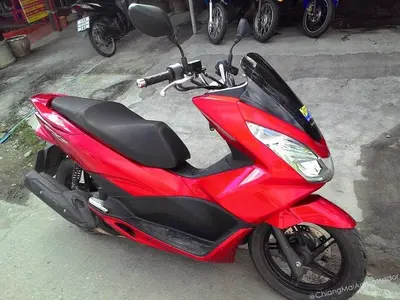
For anyone staying more than two weeks, renting a motorbike remains the highest-value transport decision available in Chiang Mai. The city was designed around two wheels. Sois that are impassable to cars, parking anywhere for free, and the ability to cover the full geography of the city in minutes rather than a Grab-dependent hour.
Monthly rental costs for a reliable semi-automatic 125cc scooter run 2,500-4,000 THB per month from reputable shops. Automatic scooters (easier for beginners) are on the same price range. Manual 150-250cc bikes for longer touring runs start around 3,500-5,000 THB per month.
The risk is real and should not be minimised. Chiang Mai's roads have hazards specific to the city: sand on corners after rain, food delivery riders running lights, and tourist groups on unfamiliar bikes around the Old City. Wear a helmet every single time. See the motorbike rental guide and the road rules guide before you ride.
Full Transport Comparison: 2026
| Mode | Best For | 2026 Price | Rating |
|---|---|---|---|
| Red Songthaew | Short hops within the moat | 30-50 THB shared | 3/5 (negotiation required) |
| Coloured Songthaew | Suburban commutes along fixed routes | 20-50 THB | 4/5 (unbeatable on cost) |
| LOMO EV Tuk-Tuk | Tours and hourly hire, Old City temples | From about 1,500 THB a half-day | 4/5 (quiet, book ahead) |
| Bolt | Daily city and outer-suburb rides | 70-130 THB | 4/5 (check first) |
| Grab | Airport, rain, late night, safety priority | 80-250 THB | 4/5 (best safety features) |
| Maxim | Long rural runs (Mae Rim, Hang Dong) | 120-200 THB | 3/5 city, 4/5 rural |
| RTC City Bus 24 | Airport to Old City/Nimman (budget) | About 50 THB from the airport | 3/5 (cheap, limited hours) |
| Chiang Mai Tram | Old City temples, markets and riverside | 20 THB a ride, 99 THB a day | New, every 15 minutes |
| Motorbike Rental | Total freedom for long-stay residents | 2,500-4,000 THB/month | 4/5 (requires valid IDP) |
Key Takeaways
Chiang Mai in 2026 has more transport options than at any point in its history. Electric tuk-tuks and the new tram are making the Old City quieter. The app war is keeping ride prices competitive. The Wing 41 shortcut is now legitimately accessible. The suburban Songthaew colour network remains the cheapest way to reach any outer district. And the IDP rule is enforced daily with real financial consequences for the underprepared. Match your transport choice to your journey type, always carry your licence documentation, and check three apps before confirming any ride.
Guru Tips
- Always check Bolt first, then Grab, then Maxim. Keep Maxim as your rural backup for when you are stuck at a remote cafe past the Superhighway. The three-app check adds 30 seconds and frequently saves 30-50 THB.
- The Wing 41 bypass is worth knowing but not worth gambling on. If you have a morning flight, arrive at the gate at 06:05, not 08:55. The queues build toward the end of the window and the guards close promptly.
- The Santitham morning market Songthaew stop (junction of Soi Santitham 1 and the main road, 06:30 onwards) is where local residents board the red trucks heading into the city. Joining that queue at 07:15 costs 30-40 THB and gives you 20 minutes of real Chiang Mai commuter life. Better than any coffee shop orientation session.
Frequently Asked Questions
What is the cheapest way to get around Chiang Mai?
The coloured Songthaew network. Fixed suburban routes run for 20-50 THB. Within the city, a red Songthaew shared ride is 30-40 THB. Most are now charging 40 THB though some still charge 30 THB. Nothing else comes close on cost for regular commuting.
Is Grab or Bolt cheaper in Chiang Mai?
Bolt is typically 10-20 THB cheaper than Grab on equivalent city journeys. Maxim is often cheapest for long-distance runs past the Superhighway (Mae Rim, Hang Dong, San Sai). Check all three before confirming any ride.
Can I use my foreign driving licence to ride a motorbike in Thailand?
No. Your home country licence alone is not sufficient. You need an International Driving Permit (IDP) with a motorcycle endorsement, carried alongside your home licence. An IDP covering car-class only does not cover a scooter. Police run daily checkpoints and fines run 500-1,000 THB.
What is the Wing 41 shortcut and who can use it?
Wing 41 is a Royal Thai Air Force base with an internal road that bypasses the Nimman-to-airport congestion. Normally you need the free annual Wing 41 pass to use it during daylight hours. Since 2025, to ease traffic during road works, the gate also lets people through without a pass during rush hour (06:00-09:00 and 15:00-18:00) if they show ID or a passport. Shirts required, and helmets on motorbikes.
How do I get from Chiang Mai Airport to Nimman cheaply?
The cheapest way is the RTC city bus 24. Take 24R for Nimman. It leaves from outside arrivals, costs about 50 THB from the airport, takes cash or Thai QR, and runs roughly 07:00 to 19:00. Grab or Bolt will get you there in 15-20 minutes for 80-130 THB if you prefer speed.
Is there a tram in Chiang Mai?
Yes. The Chiang Mai Tram by Lannatique opened on 18 November 2026. It is an electric, tram-styled bus on tyres that runs a 13.8 km loop with 15 stops round the Old City, Tha Phae and the riverside, every 15 minutes from 10:00 to 21:00. A ride is 20 THB or a day pass is 99 THB, and over-60s ride free.
What are LOMO EV tuk-tuks and how do I book one?
LOMO runs electric tuk-tuks in Chiang Mai, sold mainly as guided tours and hourly hire with a driver, from about 1,500 THB for a half-day. Book through LOMO or travel sites such as KKday, Pelago and TAGTHAi. Some guides mention single rides in the LOMO app, but check current fares in the app before you count on it.
How much does it cost to rent a motorbike in Chiang Mai long-term?
A reliable 125cc semi-automatic scooter runs 2,500-4,000 THB per month from reputable rental shops. Manual 150-250cc bikes for touring start around 3,500-5,000 THB per month. Daily rental (for short stays) is typically 200-300 THB per day. Always carry your IDP with motorcycle endorsement.
What is the best way to get around Chiang Mai?
For most visitors the best way is a ride app (check Bolt, Grab and Maxim, usually 70 to 150 THB in town) plus red songthaews at 30 to 40 THB for short hops. Long-stay residents usually rent a scooter for 2,500 to 4,000 THB a month, but only with a valid motorcycle licence. Round the Old City, the new tram costs 20 THB a ride.