How to retire in Thailand from Australia
Claim the Age Pension before you leave Australia, because you cannot claim it from Thailand. Then get a Thai retirement visa (age 50 or over, with 800,000 THB in a Thai bank or 65,000 THB a month in income), arrange private health insurance because Medicare stops at the border, and get tax advice on how Thailand treats the money you bring in.
I have helped a lot of Australians settle in Chiang Mai over 16 years, and the ones who struggle almost always made the same mistake: they sorted the Thai side first and the Australian side second. Your pension, your super and your tax residency are much harder to fix from Thailand than from home. So this guide starts in Australia and ends in Chiang Mai.
The pension figures below come from Services Australia and were current in November 2026. Thai visa rules and Australian payment rules both change, so check the official pages, which are linked, before you act. This is general information, not financial advice.

Step by Step: Retiring to Thailand from Australia
- Claim the Age Pension before you leave. You can lodge your claim up to 13 weeks before you reach Age Pension age, and you must meet all the rules on the day you turn that age. If you move to Thailand first, you cannot claim until you move back to Australia or to a country with a social security agreement.
- Tell Services Australia you are moving. Call before you go so they can switch you to overseas payments. Payments can go to an Australian bank account in Australian dollars or to a bank account overseas.
- Sort out tax residency. Leaving Australia for good usually makes you a non-resident for Australian tax, which changes how your income and super are taxed. Thailand also taxes foreign income that a Thai tax resident brings into the country. Get advice from someone who handles both countries before you move money.
- Arrange health insurance. Medicare does not cover you overseas, and if you are away more than 12 months you may need to re-enrol when you come back. Buy international or Thai cover before you leave, while you are healthy enough to get it.
- Choose your visa route. Either apply for a Non-Immigrant O-A retirement visa through the Thai e-Visa system before you leave, or enter Thailand and apply for a retirement extension at Chiang Mai Immigration. See the retirement visa guide for both routes.
- Open a Thai bank account and move your 800,000 THB early. The money has to sit in the account for a set period before Immigration will accept it, so the sooner it is there, the sooner you can apply. Our guide to opening a bank account covers what the banks ask for.
- Land softly. Rent short-term for the first week or two and look at long-term rentals in person. The where to stay guide explains how.
- Keep up with the paperwork. Every year you renew your extension, every 90 days you report your address, and your landlord files a TM30. The 90-day reporting guide covers both.
Your Age Pension in Thailand
The Age Pension can be paid while you live in Thailand, but it changes once you are overseas long term. According to Services Australia, people living outside Australia long term are paid every 4 weeks, at the basic rate. From 20 September 2026 the maximum basic rate is A$29,520.40 a year for a single person and A$44,506.80 for a couple who are both eligible. The supplements paid to pensioners in Australia are not part of that figure.
Your years in Australia matter. After 26 weeks outside Australia, your rate generally depends on your Australian working life residence: the time you lived in Australia between age 16 and Age Pension age. With 35 years you can get the full rate. With fewer, you get a proportional rate, so someone with 20 years gets about 20/35ths. The income and assets tests still apply.
Coming back changes things. If you return to live in Australia and start getting the Age Pension after you return, Services Australia says your payment may stop if you travel outside Australia within 2 years of your return. Plan any move back carefully.
| Situation | What happens |
|---|---|
| Already on the Age Pension, then move to Thailand | Payment can continue overseas; tell Services Australia before you go |
| Not yet claimed, still in Australia | Claim up to 13 weeks before Age Pension age, before you leave |
| Already living in Thailand, never claimed | You cannot claim from Thailand; you must move back to Australia first |
| After 26 weeks overseas | Rate based on Australian working life residence; 35 years for the full rate |
| Return to Australia, then leave again within 2 years | Payment may stop |
The Thai Retirement Visa for Australians
Australians can retire in Thailand from age 50. The financial test is the same for every nationality: 800,000 THB in a Thai bank account, or 65,000 THB a month in income, or a combination of the two. Thai Immigration now generally wants to see pension income arriving in your Thai bank account each month, so set up a regular transfer early if you plan to use the income route.
The O-A visa applied for from Australia requires health insurance. Thailand's visa-exempt stay for Australians dropped to 30 days on 15 September 2026, so if you plan to fly in and convert, start the paperwork quickly. The retirement visa guide covers the documents, fees and the money-seasoning rules in detail, and if your income is high, look at the 10-year LTR visa.
Super, Tax and Money
Superannuation stays in Australia. You can draw it from Thailand once you meet a condition of release, such as retiring after your preservation age. Moving overseas does not unlock it early.
Tax is where Australians get caught. Becoming a non-resident for Australian tax changes your rates and removes the tax-free threshold. On the Thai side, anyone in Thailand for 180 days or more in a calendar year is a Thai tax resident, and since 2024 Thailand taxes foreign income that a resident brings into the country. How the Australia and Thailand tax treaty applies to the Age Pension, super pensions and investment income is not simple, and advisers do not all agree. Get advice from a cross-border tax specialist before you move large amounts.
Moving money: see our guide to currency in and out of Thailand, including the cash limits at the border.
Healthcare
Chiang Mai has good private hospitals and is a fraction of the cost of private care in Australia, but you pay for it yourself because Medicare does not cover you overseas. Most Australian retirees here carry private international or Thai health insurance, and the premiums rise with age, so buy a policy you can keep. See healthcare costs in Chiang Mai and our insurance guide.
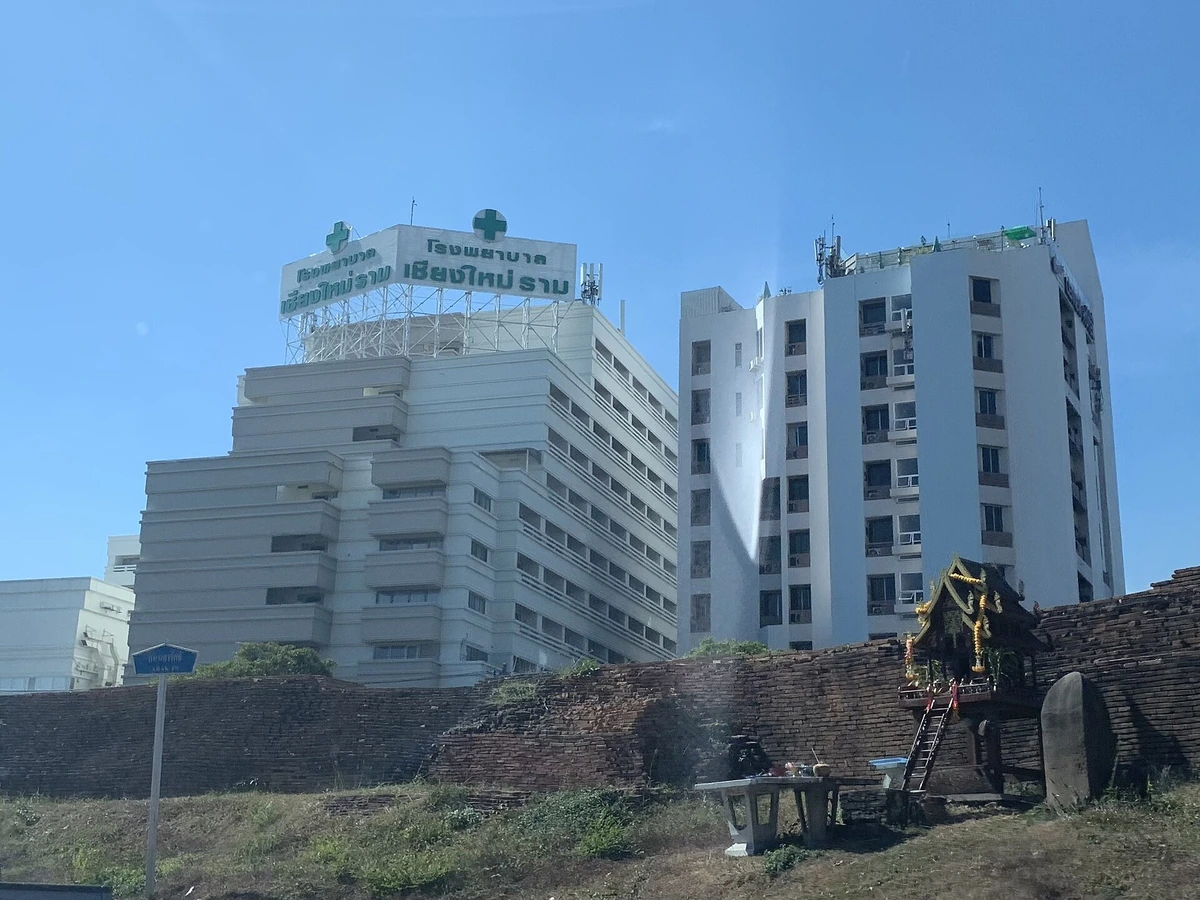
Chiang Mai Ram Hospital, one of the private hospitals many expats use. Photo: Chainwit., CC BY 4.0, via Wikimedia Commons, resized.
Is the Age Pension Enough in Chiang Mai?
For most single people, yes. The full single overseas rate of A$29,520.40 a year works out at about A$2,460 a month. A comfortable single life in Chiang Mai costs about 30,000 to 50,000 THB a month, which is roughly A$1,330 to A$2,210 at around 22.6 THB to the dollar. That leaves room for insurance and travel. The exchange rate moves, so keep a buffer, and remember that a part pension or a proportional rate can be much lower.
| Monthly item | THB | About A$ |
|---|---|---|
| 1-bed condo, Nimman or Santitham | 12,000 to 18,000 | 530 to 795 |
| Food, local and some Western | 7,000 to 11,000 | 310 to 485 |
| Transport | 3,000 to 5,000 | 130 to 220 |
| Health insurance | 3,000 to 5,000 | 130 to 220 |
| Utilities, internet, phone | 2,500 to 3,500 | 110 to 155 |
| Entertainment and lifestyle | 2,500 to 7,500 | 110 to 330 |
| Total | 30,000 to 50,000 | 1,330 to 2,210 |

A Chiang Mai expat lunch group. Finding your people is half of settling in.
Practical Matters
- Flights home: there are no direct flights from Chiang Mai to Australia, so you connect through Bangkok, Singapore or Kuala Lumpur.
- Driving: get a Thai licence rather than relying on your Australian one. See the Chiang Mai driving licence guide.
- Wills and end of life: make a Thai will for Thai assets and tell someone where your papers are. Our guide to dying in Thailand is not cheerful reading, but it saves families real pain.
- Smoky season: March and April bring heavy smoke to Chiang Mai. Many retirees spend those weeks on the coast or back in Australia. Read the smoky season guide before you commit.
Key Takeaways
Do the Australian side first: claim the Age Pension before you leave, tell Services Australia, get tax advice and buy health insurance. Then sort the Thai retirement visa and your 800,000 THB or 65,000 THB a month. The full single overseas pension of about A$2,460 a month comfortably covers a 30,000 to 50,000 THB life in Chiang Mai, as long as you have 35 years of Australian residence and keep a buffer for the exchange rate.
Frequently Asked Questions
How to retire in Thailand from Australia?
Get a retirement visa (age 50 or over, with 800,000 THB in a Thai bank or 65,000 THB a month in income), and sort your pension before you leave. Claim the Age Pension while still in Australia, as there is no social security agreement with Thailand. After 26 weeks overseas your rate depends on your years of Australian residence (35 for the full rate). Medicare does not cover Thailand, so buy private health insurance.
Can I get the Australian Age Pension while living in Thailand?
Yes, if you claim it before you leave Australia. Payments can continue while you live in Thailand, paid every 4 weeks at the basic rate. You cannot make a new claim from Thailand, because Australia has no social security agreement with Thailand.
How much is the Age Pension if I live in Thailand?
From 20 September 2026 the maximum basic rate for people living outside Australia is A$29,520.40 a year for a single person and A$44,506.80 for a couple. After 26 weeks overseas the amount depends on how many years you lived in Australia between 16 and Age Pension age, with 35 years needed for the full rate.
Does Medicare cover me in Thailand?
No. Medicare does not cover you overseas, so you need private international or Thai health insurance. If you live overseas for more than 12 months, you may need to re-enrol in Medicare when you return to Australia.
Can I access my super if I live in Thailand?
Yes, once you meet a condition of release, such as retiring after your preservation age. Your super stays with your Australian fund and can be paid to you overseas. How Thailand taxes super you bring into the country is complicated, so get cross-border tax advice.
Is the Age Pension enough to live on in Chiang Mai?
For most single people, yes. The full single overseas rate is about A$2,460 a month, and a comfortable single life in Chiang Mai costs about 30,000 to 50,000 THB a month, roughly A$1,330 to A$2,210. A part pension or a proportional rate may not be enough on its own.
Guru Tip
- Lodge your Age Pension claim before you book your one-way flight. Waiting until you are settled in Chiang Mai is the most expensive mistake Australians make here, because the only fix is moving back.
- Do a trial run of three months that includes March. If you still love Chiang Mai through smoky season, you will love it the rest of the year.
- Keep an Australian bank account and card open. It makes pension payments, super withdrawals and paying for anything back home far simpler.