How to retire in Thailand from the USA
Get a Thai retirement visa (age 50 or over, with 800,000 THB in a Thai bank or 65,000 THB a month in income), have your Social Security paid straight into a Thai bank, and buy private health insurance, because Medicare does not pay for care in Thailand. You still file US taxes every year as a US citizen, wherever you live.
Of all the foreigners I have helped settle in Chiang Mai over 16 years, Americans are the biggest group, and there are good reasons. Social Security can be paid directly into a Thai bank, the US has a full Consulate General right here in Chiang Mai, and a comfortable life costs a fraction of what it does at home. The traps are mostly on the American side: health cover, taxes and banking.
Figures below were checked in November 2026 at about 33 THB to the US dollar. Thai visa rules and US benefit rules both change, so check the official sources before you act. This is general information, not financial or tax advice.

Step by Step: Retiring to Thailand from the USA
- Decide on Medicare before you go. Medicare does not pay for care in Thailand. If you drop Part B and later move back, you can face a late enrolment penalty for the rest of your life. Many retirees keep Part B as insurance for a return home, and buy private cover for Thailand as well. Decide this with your eyes open.
- Set up Social Security for overseas. Tell the Social Security Administration your new address and choose where payments go: a US account, or direct deposit into a Thai bank, which converts the payment to baht.
- Get your tax position clear. US citizens are taxed on worldwide income wherever they live, so you keep filing with the IRS. Thailand can also tax foreign income a Thai resident brings into the country, subject to the US-Thailand tax treaty. Read our US expat tax guide and talk to an expat tax specialist before you move money. My friend Thomas Carden at American International Tax Advisers works with Americans in Chiang Mai every day.
- Buy health insurance. International or Thai cover, bought while you are healthy enough to get it. Premiums rise with age, so pick a policy you can keep.
- Choose your visa route. Apply for a Non-Immigrant O-A retirement visa through the Thai e-Visa system before you leave, or arrive and apply for a retirement extension at Chiang Mai Immigration. The retirement visa guide covers both.
- Open a Thai bank account and move your money early. The 800,000 THB has to sit in the account for a set period before Immigration accepts it. If you use the income route, set up a monthly transfer of at least 65,000 THB into your Thai account. See opening a bank account.
- Land softly. Rent short-term for the first week or two and look at long-term rentals in person. The where to stay guide explains how.
- Keep up with the paperwork. Every year you renew your extension, every 90 days you report your address, and your landlord files a TM30. The 90-day reporting guide covers both.
Social Security in Thailand
Social Security keeps paying while you live in Thailand. You can leave it going to your US bank account, or use international direct deposit into a Thai bank. According to the US Embassy, payments to Thai banks are converted to baht at the international exchange rate, the US Treasury charges no fee, though the Thai bank may, and payments in US dollars are not available that way. Changing to a foreign bank account is done on a paper form, not through the online my Social Security account.
Expect a proof-of-life questionnaire from the Social Security Administration from time to time. Answer it promptly, because payments are suspended if you do not. Under the US-Thailand tax treaty, US Social Security is generally taxed only by the US, but confirm your own position with a tax adviser.
Can you retire on Social Security alone? Often, yes. A comfortable single life in Chiang Mai costs about 30,000 to 50,000 THB a month, roughly $900 to $1,500, so a typical retirement check of around $2,000 covers it with room for insurance. A smaller check, or a couple on one benefit, needs a tighter budget or savings on top.
Medicare and Health Insurance
Medicare generally does not cover care outside the United States, so in Thailand you pay for treatment yourself or through private insurance. Chiang Mai has good private hospitals at a fraction of US prices, but a serious illness can still cost thousands of dollars. Most American retirees here carry an international or Thai health policy.
The hard question is Part B. Keeping it costs a monthly premium for cover you cannot use in Thailand. Dropping it saves that money, but if you move back and re-enrol, the late penalty is added to your premium for life. Medicare Advantage plans generally do not help abroad either. See healthcare costs in Chiang Mai and our insurance guide.
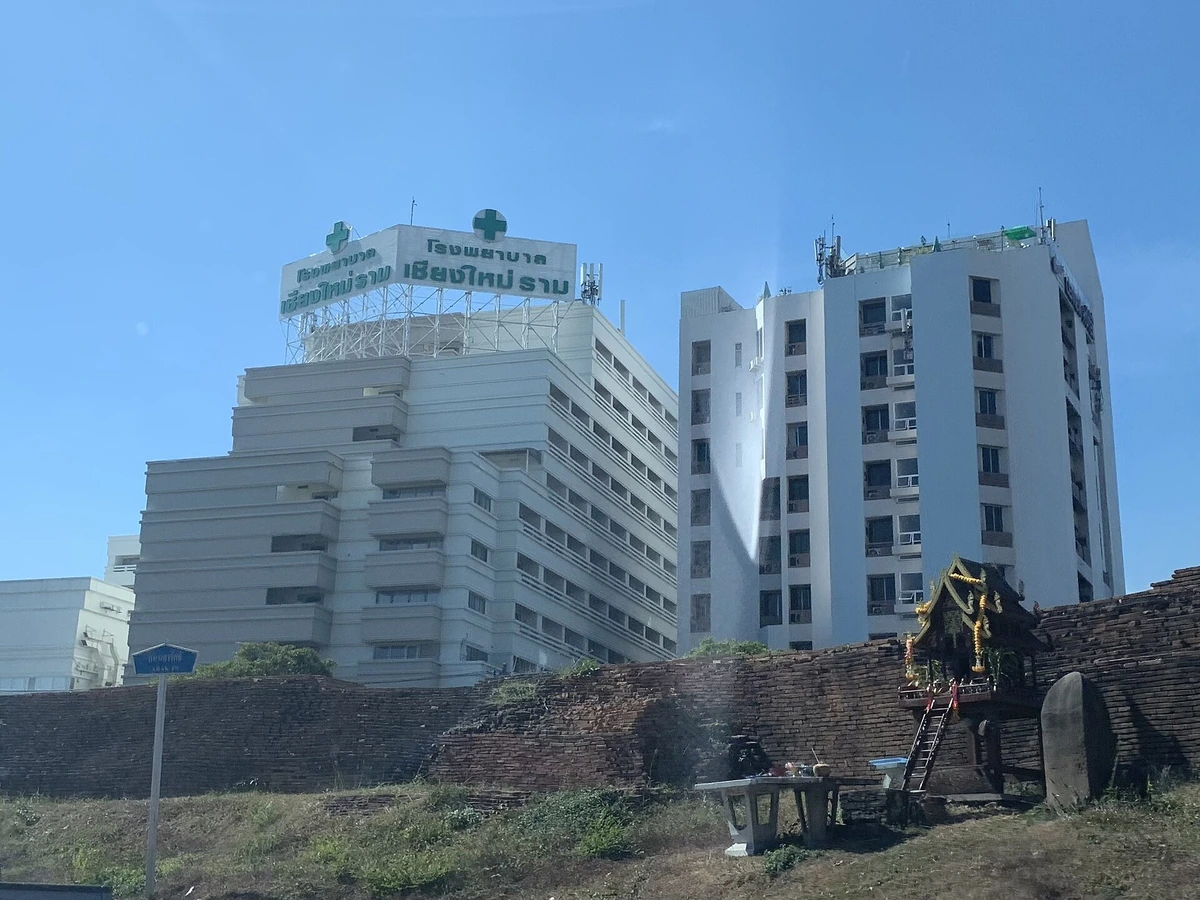
Chiang Mai Ram Hospital, one of the private hospitals many expats use. Photo: Chainwit., CC BY 4.0, via Wikimedia Commons, resized.
The Thai Retirement Visa for Americans
Americans can retire in Thailand from age 50. The financial test is the same for every nationality: 800,000 THB (about $24,000) in a Thai bank, or 65,000 THB (about $1,970) a month in income, or a combination. The US Embassy stopped providing income letters for Thai visas some years ago, so most Americans use the bank deposit, or show the monthly income arriving in their Thai account.
US citizens have been limited to 30 days visa-free since 15 September 2026, so if you plan to fly in and convert, start the paperwork quickly. The O-A visa from the US requires health insurance. The retirement visa guide covers documents, fees and the money-seasoning rules, and if your income is high, look at the 10-year LTR visa.
Taxes and Banking
The US taxes its citizens on worldwide income no matter where they live, so you keep filing a US return every year. You also report foreign bank accounts on an FBAR when the total is above $10,000 at any point in the year, and Thai banks report US account holders to the IRS under FATCA. Some Thai banks are cautious with Americans for that reason.
On the Thai side, anyone in Thailand for 180 days or more in a year is a Thai tax resident, and since 2024 Thailand taxes foreign income that a resident brings into the country, subject to the treaty. IRA and 401(k) withdrawals are where people get caught. Our US expat tax guide covers FBAR, FATCA, the treaty and Thai tax in detail.
For professional help, Thomas Carden of American International Tax Advisers, who co-presented the Chiang Mai expat tax seminar our guide draws on, has written detailed guides on US tax planning for retiring in Thailand, filing US taxes from Thailand and US expat taxes in Thailand for 2026. One consultation before you move money is far cheaper than fixing a mistake later.
The US Consulate General in Chiang Mai
Chiang Mai has its own US Consulate General, so you do not have to go to the embassy in Bangkok for most things. It moved into a large new compound on the Chiang Mai to Lampang Superhighway in January 2026, and serves more than 21,000 Americans living in northern Thailand. It handles American citizen services such as passports and notary work, so you rarely need to go to Bangkok. Book appointments through the consulate's website. Our embassies and consulates page lists contacts.
Is Chiang Mai Affordable on a US Retirement?
| Monthly item | THB | About US$ |
|---|---|---|
| 1-bed condo, Nimman or Santitham | 12,000 to 18,000 | 365 to 545 |
| Food, local and some Western | 7,000 to 11,000 | 210 to 335 |
| Transport | 3,000 to 5,000 | 90 to 150 |
| Health insurance | 3,000 to 5,000 | 90 to 150 |
| Utilities, internet, phone | 2,500 to 3,500 | 75 to 105 |
| Entertainment and lifestyle | 2,500 to 7,500 | 75 to 225 |
| Total | 30,000 to 50,000 | 900 to 1,500 |
Health insurance here is a basic figure. Comprehensive cover for an older retiree can cost much more, so get real quotes for your age. For the full picture, see the cost of living guide.

The Chiang Mai Expats Club breakfast: an easy first step into the retiree community.
Practical Matters
- Flights home: there are no non-stop flights from Thailand to the US, so expect one or two stops, often in Tokyo, Seoul, Taipei, Hong Kong or the Gulf.
- Driving: get a Thai licence rather than relying on your US one. See the Chiang Mai driving licence guide.
- Voting: you can still vote in US federal elections from abroad by absentee ballot through your last US state of residence.
- Wills and end of life: make a Thai will for Thai assets and tell someone where your papers are. Our guide to dying in Thailand saves families real pain.
- Smoky season: March and April bring heavy smoke to Chiang Mai. Many retirees spend those weeks on the coast or back in the US. Read the smoky season guide first.
Key Takeaways
Decide on Medicare Part B and buy health insurance before you leave, point your Social Security at the right bank, and keep filing US taxes. Then sort the Thai retirement visa with 800,000 THB in the bank or 65,000 THB a month. A comfortable Chiang Mai life costs about $900 to $1,500 a month, which a typical Social Security check covers, and the US Consulate General is right here in town.
Frequently Asked Questions
How do I retire in Thailand as an American?
Get a Thai retirement visa (age 50 or over, with 800,000 THB in a Thai bank or 65,000 THB a month in income), arrange for Social Security to be paid in Thailand or to your US account, and buy private health insurance because Medicare does not cover care in Thailand. You must still file US taxes every year.
Can I get Social Security in Thailand?
Yes. Social Security keeps paying while you live in Thailand. You can have it deposited into a US account, or into a Thai bank by international direct deposit, where it is converted to baht. Answer the Social Security Administration's proof-of-life questionnaires promptly, or payments can be suspended.
Does Medicare work in Thailand?
No. Medicare generally does not cover medical care outside the United States, so you need private international or Thai health insurance. If you drop Medicare Part B and later move back, you may pay a late enrolment penalty for life, so decide carefully before you leave.
Is there a US consulate in Chiang Mai?
Yes. The US Consulate General in Chiang Mai moved into a new compound on the Chiang Mai to Lampang Superhighway in January 2026. It serves more than 21,000 Americans in northern Thailand and handles passports, notary services and help in emergencies.
Can I retire in Thailand on Social Security alone?
Often, yes. A comfortable single life in Chiang Mai costs about 30,000 to 50,000 THB a month, roughly $900 to $1,500, so a typical Social Security check of around $2,000 covers it with room for insurance. A smaller benefit needs a tighter budget or savings on top.
How long can Americans stay in Thailand without a visa?
30 days. Since 15 September 2026, US citizens arriving without a visa get 30 days, down from 60. To stay longer you need a visa such as the retirement visa, the DTV or the LTR, or an extension at an immigration office.
Guru Tip
- Keep one US bank account and one US credit card open, with a US mailing address your bank accepts. Closing everything at home makes Social Security, taxes and two-factor logins far harder from Thailand.
- Get quotes for health insurance at your real age before you commit to the move. For many retirees it turns out to be the biggest line in the budget, not rent.
- Do a trial run of three months that includes March. If you still love Chiang Mai through smoky season, you will love it the rest of the year.